MiniMax released M2.7 on March 18, 2026, with a framing that's rare in model releases: this model participated in building itself. During M2.7's development, an internal version of the model managed RL experiments, handled debugging pipelines, built its own evaluation scaffolding, and iterated improvements to its own harness — then the improved harness produced better training data for the next round. That cycle ran for months. The result is a model that, according to MiniMax, handles 30–50% of their internal ML workflows without human involvement.
The headline metrics: SWE-Pro 56.22% (approaching Opus 4.7's level), Terminal-Bench 2 57.0%, VIBE-Pro 55.6%, GDPval-AA ELO 1495 (highest among open-source models). On MLE Bench Lite — autonomous machine learning competition entries — M2.7 averaged 66.6% medal rate, tying with Gemini 3.1 and finishing third behind Opus 4.6 (75.7%) and GPT-5.4 (71.2%).
The Self-Evolution Architecture
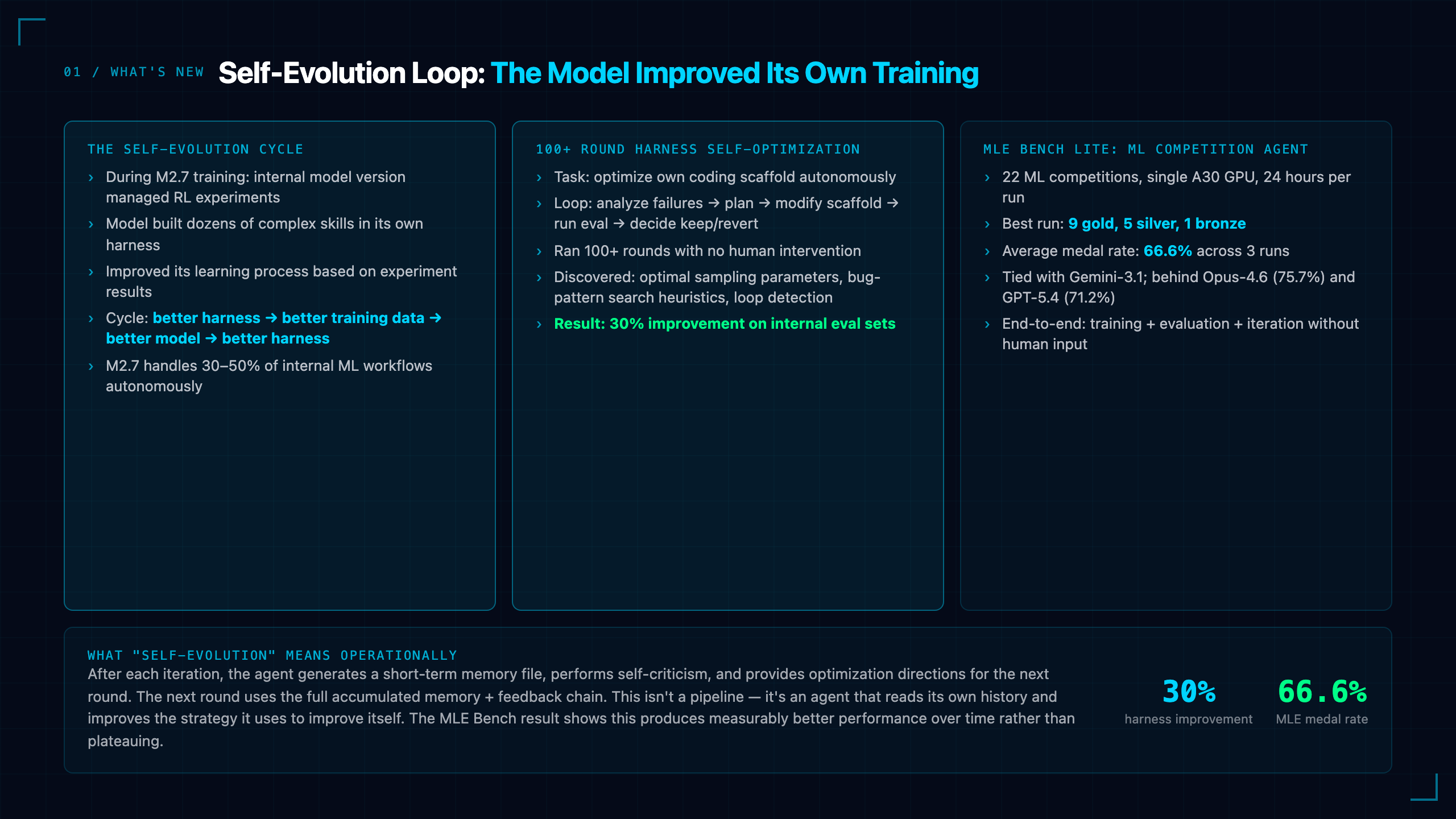
The self-evolution process M2.7 participated in has three components, which MiniMax describes as short-term memory, self-feedback, and self-optimization running in a loop:
- After each iteration round, the agent generates a short-term memory file recording what worked and what didn't.
- It performs self-criticism on the current results and identifies potential directions.
- The next round runs self-optimization using the accumulated memory and feedback chain from all prior rounds.
This is not a static pipeline. In one specific test, M2.7 was tasked with optimizing its own scaffolding for coding performance. It ran autonomously through 100+ iterations of "analyze failure trajectories → plan changes → modify scaffold code → run evaluations → compare results → decide to keep or revert." During this process it discovered effective optimizations independently — parameter search over temperature, frequency penalty, and presence penalty combinations; added workflow guidelines like "after fixing a bug, automatically search for the same pattern in other files"; loop detection and other agent loop improvements. Final result: 30% improvement on internal evaluation sets, with no human involvement after the initial task specification.
For the MLE Bench Lite test, M2.7 competed in 22 machine learning competitions runnable on a single A30 GPU, with 24 hours per run for iterative improvement. The best run yielded 9 gold, 5 silver, 1 bronze medals. The average medal rate of 66.6% across three runs represents a model that can run ML experimentation end-to-end, including training, evaluation, and iteration, at a competitive level.
Professional Software Engineering
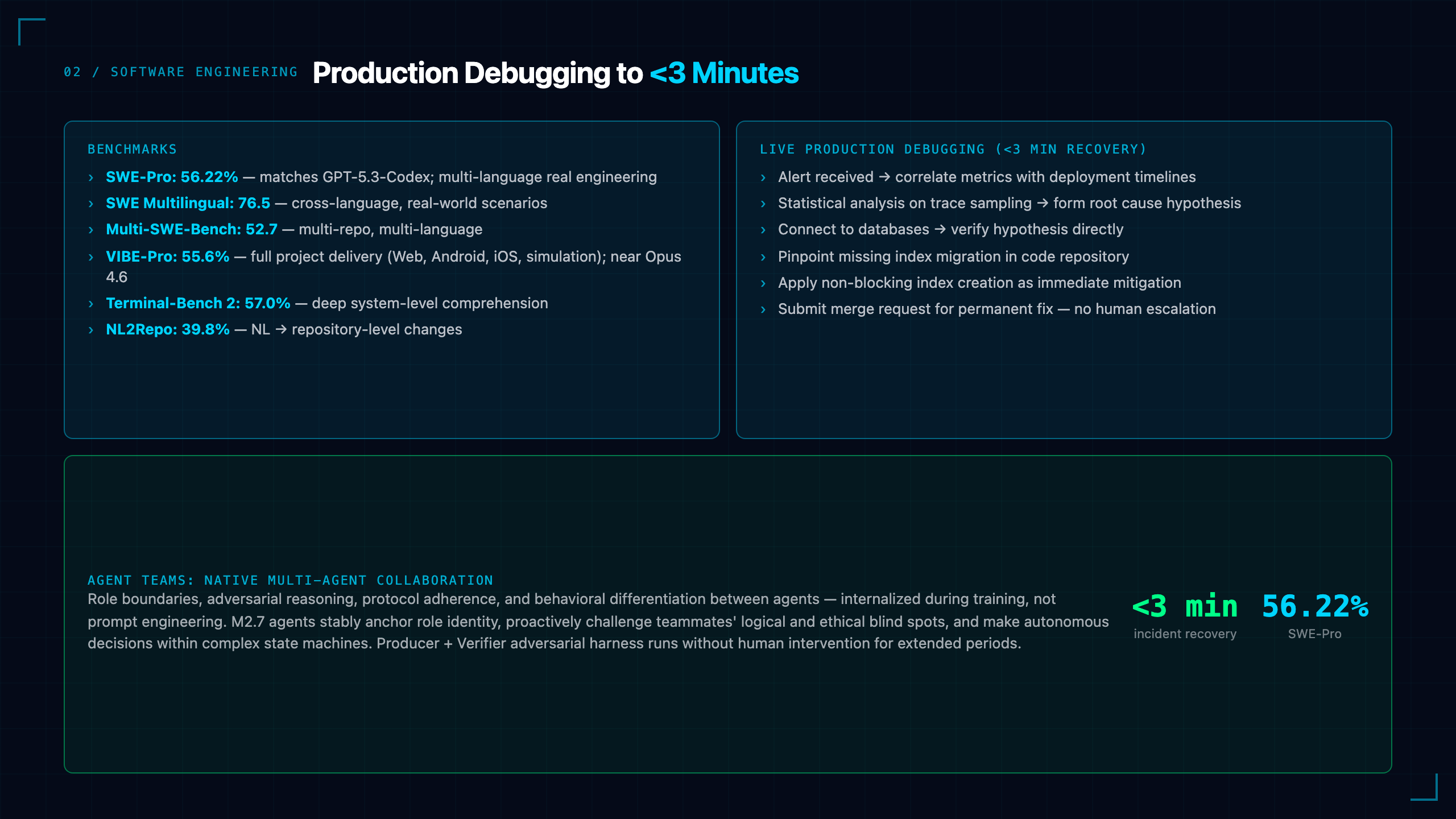
M2.7's software engineering capabilities have expanded beyond code generation to what MiniMax describes as production system understanding.
The most striking example is live production debugging. When given a production alert, M2.7's documented workflow: correlate monitoring metrics with deployment timelines → run statistical analysis on trace sampling → connect to databases to verify root cause hypotheses → pinpoint missing index migration files in the code repository → apply non-blocking index creation as immediate mitigation → submit a merge request for the permanent fix. Observability analysis, database queries, SRE-level decision sequencing — without human escalation between steps. MiniMax reports this workflow has reduced production incident recovery time to under three minutes on multiple occasions.
Benchmark numbers:
- SWE-Pro: 56.22% — matches GPT-5.3-Codex; covers multiple programming languages
- SWE Multilingual: 76.5 — real-world multilingual engineering tasks
- Multi-SWE-Bench: 52.7 — multi-repo, multi-language
- VIBE-Pro: 55.6% — end-to-end full project delivery (Web, Android, iOS, simulation); near Opus 4.6 level
- Terminal-Bench 2: 57.0% — deep system-level comprehension required
- NL2Repo: 39.8% — natural language to full repository changes
The VIBE-Pro score is operationally significant: it measures whether the model can take a product requirement and produce a complete, working codebase, not just generate code snippets. At 55.6%, M2.7 is competitive with frontier closed-source models on this task.
Agent Teams is a native capability in M2.7, not a prompting trick. Role boundaries, adversarial reasoning, protocol adherence, and behavioral differentiation between agents — these require the model to have internalized multi-agent collaboration during training. The result: stable role anchoring, proactive logical challenges between agents, and autonomous decision-making within complex state machines.
Professional Office Work
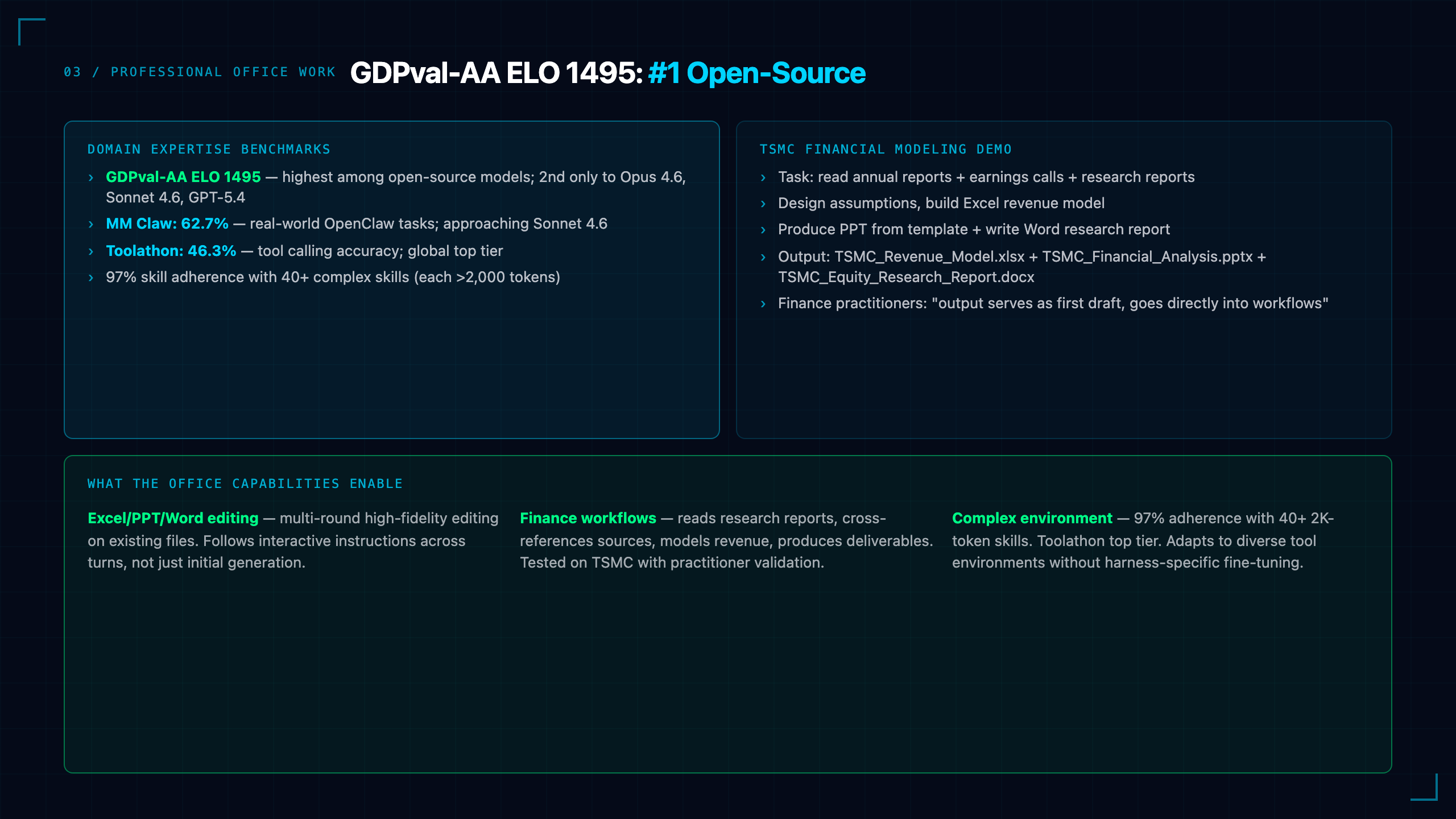
The GDPval-AA evaluation measures professional domain expertise and task delivery quality. M2.7 scored ELO 1495 among 45 models — second only to Opus 4.6, Sonnet 4.6, and GPT-5.4, ahead of GPT-5.3. For an open-source model, this is the highest score on this benchmark.
The TSMC financial modeling demonstration is the most concrete test of what this means in practice. Given a task to build a revenue model — reading annual reports, earnings call transcripts, multiple research reports, design revenue assumptions, build the Excel model, produce a PPT based on a template, write a Word research report — M2.7 completed the full pipeline autonomously: reads documents, cross-references sources, independently designs assumptions, builds the model, generates deliverables across three file formats. MiniMax reports the output "can serve as a first draft and go directly into subsequent workflows" in feedback from finance practitioners.
Complex skill adherence: in environments with 40+ complex skills each exceeding 2,000 tokens, M2.7 maintains 97% skill compliance rate. On Toolathon (tool calling accuracy), M2.7 scored 46.3%, top-tier globally. On MM Claw (OpenClaw-based real-world scenarios from personal planning to professional research), M2.7 reached 62.7% — approaching Sonnet 4.6.
OpenRoom: Agent Interaction Beyond Text
MiniMax open-sourced a preliminary demo called OpenRoom — an agent harness interaction system that moves AI interaction from plain text streams into a web GUI where everything is interactive. Character settings generate real-time visual feedback and scene interactions; agents proactively engage with their environment rather than responding to requests. This is positioned as an exploration of the intersection of agent productivity capabilities and interactive entertainment.
The combination of strong character consistency training and agentic capabilities makes M2.7 functional for interactive contexts where the model needs to maintain a stable persona across extended multi-turn interactions, not just complete tasks.
What It Means for Developers
The self-evolution framing is not just a narrative — it describes a practical capability. M2.7 can manage RL experiments, write and iterate its own scaffolding, and maintain operational context across 100+ tool-call loops. For developers building systems that need to run autonomously for extended periods, this is the relevant baseline.
The production debugging reduction to under 3 minutes translates directly: if you're building agent workflows for infrastructure operations, incident response, or log analysis, M2.7's ability to reason across observability data, codebases, and database state without manual escalation is functionally different from a model that generates good code in isolation.
The office work capabilities — GDPval-AA ELO 1495, multi-format document delivery, Excel/PPT/Word multi-round high-fidelity editing — mean that document-heavy workflows (financial analysis, legal review, research synthesis, enterprise reporting) can be handed to M2.7 as the execution layer.
Token Plan access: available at platform.minimax.io. API documentation at platform.minimax.io/docs/api-reference. Supported harnesses include Claude Code, Cursor, Cline, Roo Code, Kilo Code, OpenCode, Codex CLI, Grok CLI, Droid, and TRAE.
Bottom Line
M2.7 is the first MiniMax model where "the model participated in its own training" isn't metaphor — it's a documented process. The self-evolution loop (analyze → modify harness → evaluate → iterate) ran for months and is described as handling 30–50% of internal ML workflows. The benchmark results (SWE-Pro 56.22%, GDPval-AA #1 open-source, MLE Bench Lite 66.6%) reflect a model where self-driven capability improvement is measurable at evaluation time.
The production debugging and financial modeling demonstrations are the practical translation: this is what it looks like when a model can reason across production systems and domain-specific documents as a collaborative peer rather than a code generator.
Resources
- MiniMax M2.7 Official Blog — full technical report
- MiniMax M2.7 Model Page — capabilities and showcase
- MiniMax API Platform — API and Token Plan access
- MiniMax Agent — no-code access
MiniMax M2.7 is available at platform.minimax.io. API and Token Plan subscriptions available. Open-source exploration via OpenRoom.