There's an old joke in China's AI industry: domestic models never lose a benchmark, but they never win on actual usage. MiniMax spent years earning that reputation. M3, released June 1, makes a credible case that this time is different — while simultaneously pulling a pricing move that's generating more anger than the benchmarks are generating excitement.
Both things are true, and the tension between them tells you something real about where Chinese frontier labs are right now.
The Benchmarks Are Actually Hard This Time
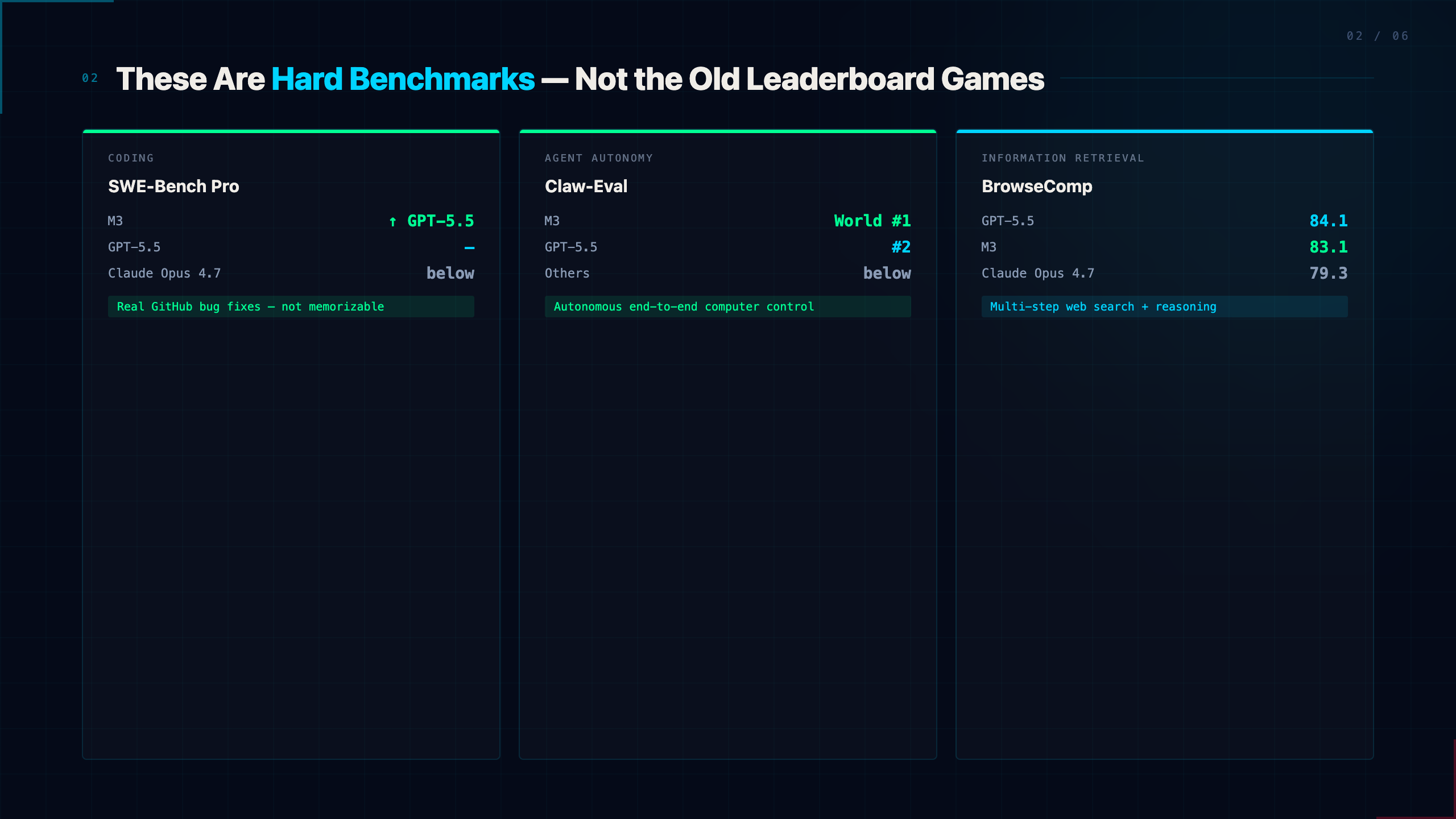
The scores that circulated at launch: SWE-Bench Pro slightly above GPT-5.5, Claw-Eval autonomous agent evaluation at world #1, BrowseComp information retrieval at 83.1 — above Claude Opus 4.7's 79.3, just below GPT-5.5's 84.1.
What makes these worth taking seriously is the benchmark selection. The old pattern — C-Eval, CMMLU, fixed Chinese-language test sets — was vulnerable to contamination. If evaluation questions overlap with training data, scores inflate and tell you nothing. M3 chose differently:
SWE-Bench Pro tests real GitHub open-source project bug fixes. The task pool comes from community submissions; it changes. You can't memorize your way to a high score — you need to actually read and fix code in unfamiliar repositories.
Claw-Eval tests autonomous computer control: end-to-end tasks where the model operates a machine without human intervention.
BrowseComp requires autonomous web search, synthesis, and multi-step reasoning across large information spaces.
These are legitimately hard evals. A model that scores well on them has demonstrated something real, not just pattern-matched on a fixed test set.
The architectural reason M3 can do this: MSA (Multi-head Sparse Attention). Standard attention over a 1M-token context has quadratic compute cost — every token attends to every other token. MSA identifies high-relevance tokens in a fast first pass and concentrates attention there, treating the rest as low-weight. The result: ~1/20th the per-token compute of the previous generation at 1M context, 9.7× faster prefill, 15.6× faster decoding. MiniMax claims M3 is the only open-source model simultaneously offering frontier coding performance, 1M context, and native multimodality.
Open-source matters here. Developers can deploy and verify independently; it's not a closed benchmark on a proprietary system.
Real-World Testing: Strong Core, Soft Edges
Independent evaluations confirmed the benchmark scores reflect genuine capability improvement — with specific gaps that matter for practical use.
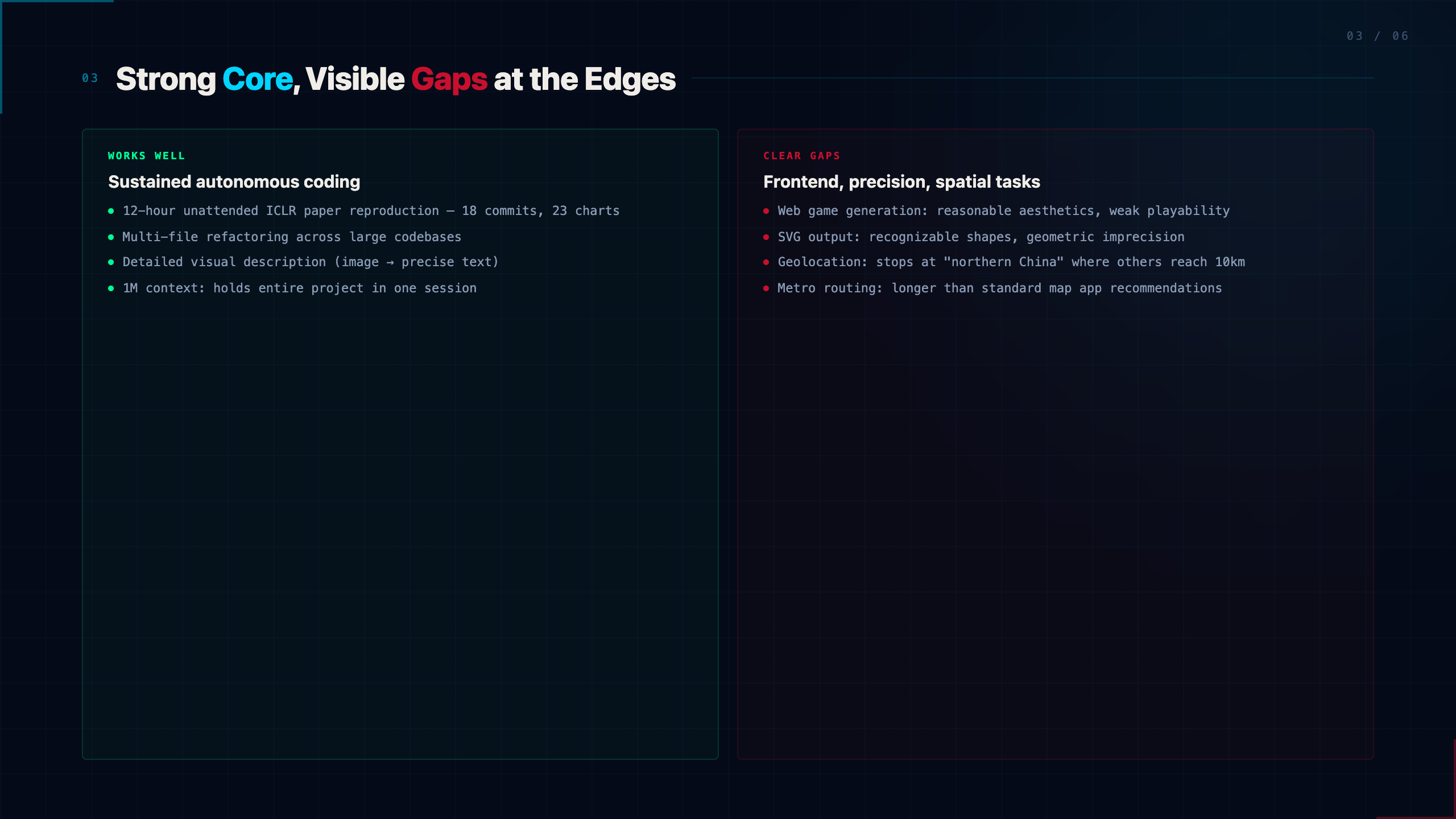
The headline demonstration: fed an ICLR award-winning paper and tasked with reproducing the core experiments from scratch, M3 ran for nearly 12 hours without human intervention, producing 18 code commits and 23 experimental charts. That's not a benchmark artifact; it's the kind of sustained, autonomous execution that coding agents need for real research tasks.
But the same evaluations surface clear limits:
Frontend and creative tasks underperform. Asked to generate a playable web racing game, M3 produced reasonable aesthetics but weak playability. SVG generation was recognizable but geometrically imprecise. The gap between "understands the requirement" and "delivers production-quality output" is visible here.
Multimodal is detailed but imprecise. Visual description is genuinely strong — M3 can identify "dust nets covering the exterior walls of high-rise buildings" from an image. But geolocation tasks reveal the ceiling: where DeepSeek and Qwen can narrow a Chinese urban scene to within 10km, M3 stops at "northern Chinese suburban area."
Navigation and spatial reasoning have gaps. Asked to plan a metro route, M3 suggested a path substantially longer than standard mapping app recommendations.
MiniMax's own framing of this is honest: existing coding benchmarks assume tasks complete in one shot. Real development involves iterative communication, changing requirements, cascading bug fixes. They built an "interactive user simulator" to test this scenario, where M3 performs well — but the gap to actual project delivery remains.
The summary is precise: M3 understands how to do things. Getting them fully done is a different standard.
The Pricing Overhaul That's Actually the Story
The technical story is positive. The business story is where it gets complicated.
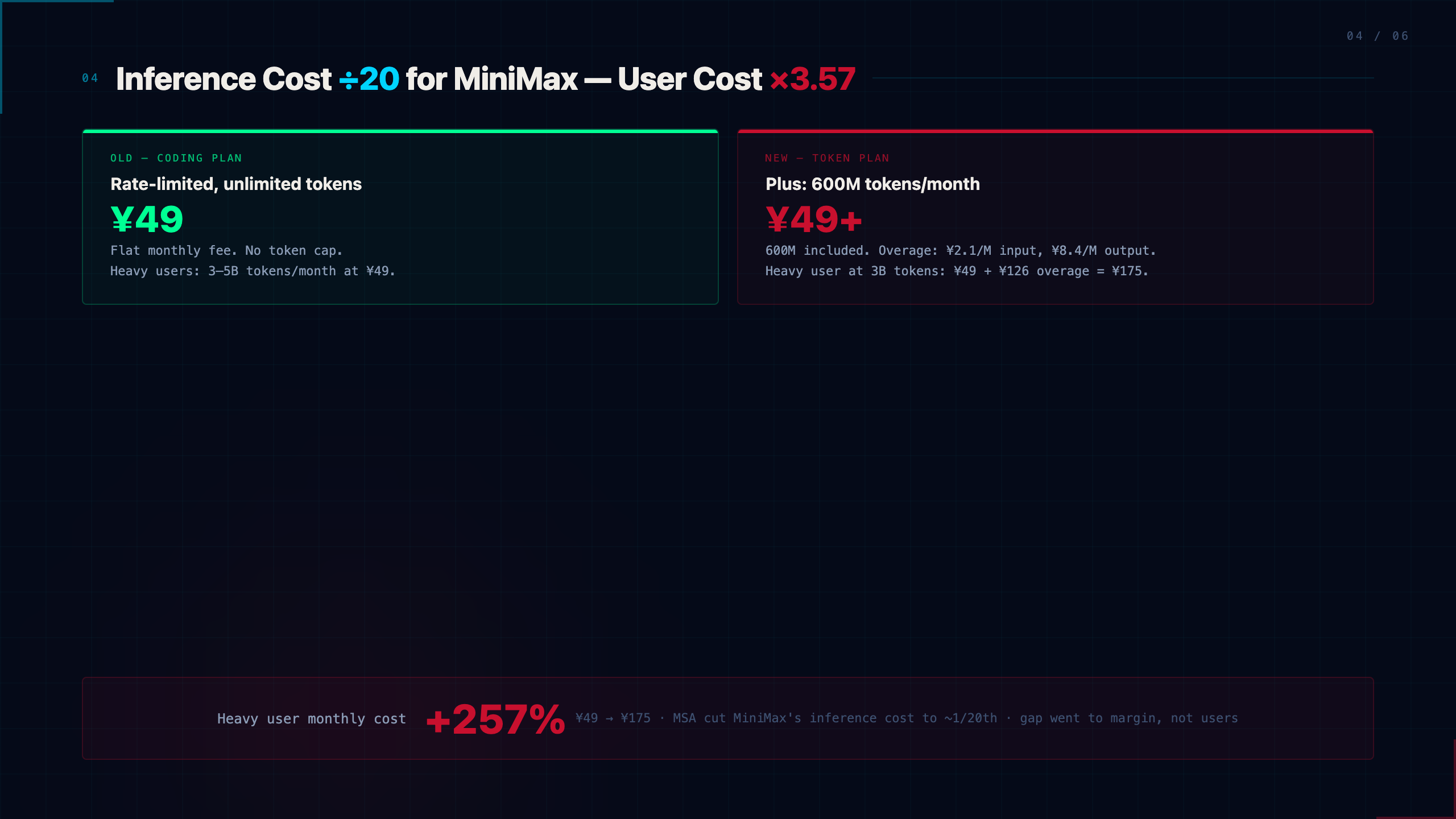
Alongside M3's launch, MiniMax restructured its subscription entirely. The previous Coding Plan was ¥49/month with rate limiting but no token cap — heavy developers running 3–5 billion tokens per month paid a flat ¥49. The new Token Plan charges by total token consumption.
The Plus tier: ¥49/month for 600M tokens.
600M sounds large. Run the math against M3's 1M context window: a single large codebase refactoring pass might consume 600K tokens. At a conservative average of 100K tokens per interaction, 600M covers 6,000 interactions. Heavy developers exhaust this in two weeks.
Overage pricing: ¥2.1/M input tokens, ¥8.4/M output tokens.
One analysis ran the numbers on a realistic heavy-usage scenario — previously 3B tokens/month at ¥49:
- Old cost: ¥49
- New cost: ¥49 (600M) + ¥126 overage (2.4B remaining) = ¥175
- Increase: 257%
The structural irony is sharp: M3's MSA architecture reduces MiniMax's inference cost to ~1/20th of the previous generation. The efficiency gains went to the company's margin, not to users. Simultaneously, the 1M context window that's M3's headline feature encourages higher token consumption per session. You get a faster car and a smaller gas tank.
For moderate users, the impact is much smaller. But the heavy users who built workflows around the old unlimited model — the developers who stress-tested the system and generated the word-of-mouth — are the ones who got hit hardest.
The IPO Timing
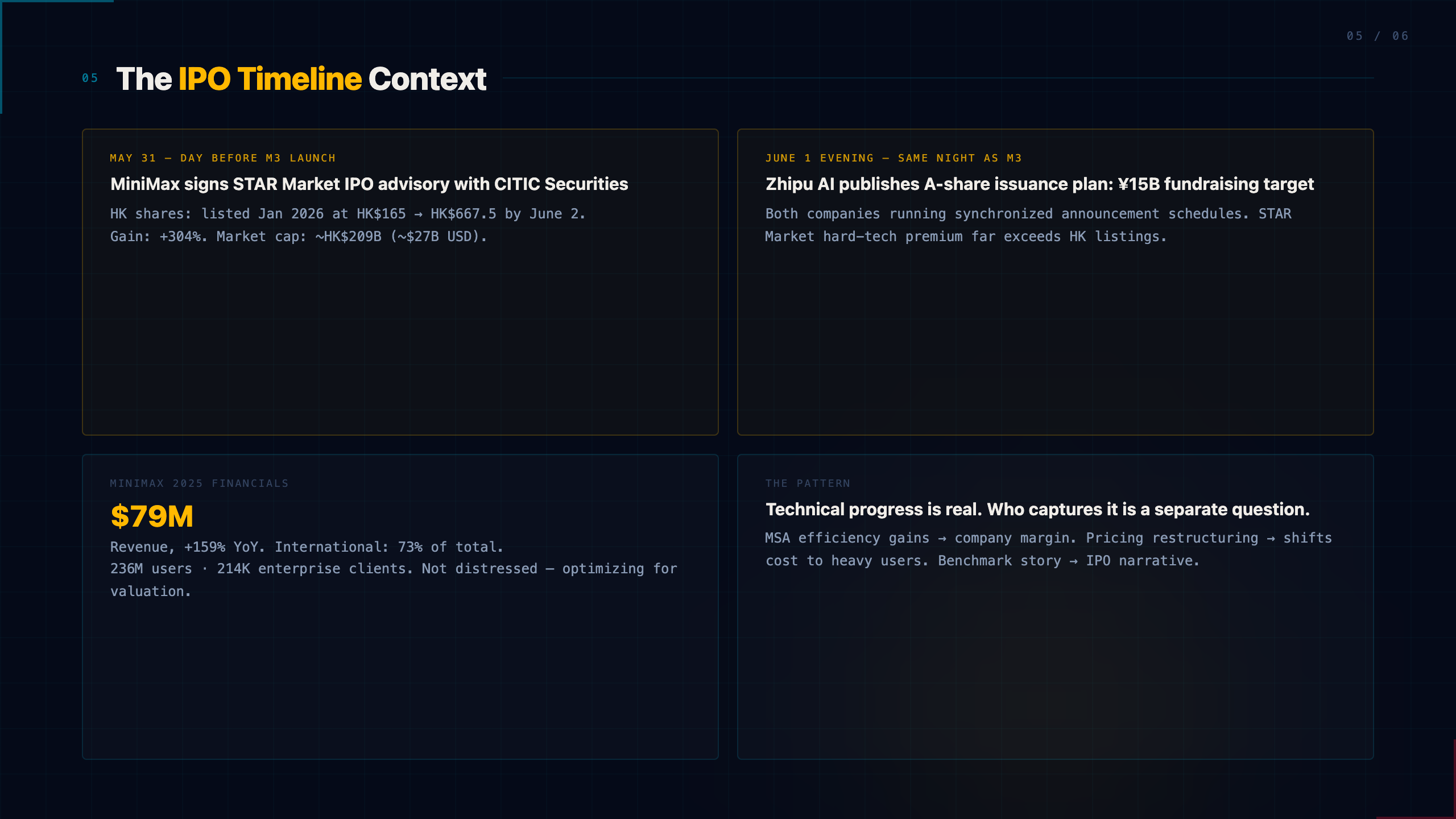
One day before M3 launched (May 31), MiniMax announced an A-share STAR Market IPO advisory agreement with CITIC Securities. Its Hong Kong shares, listed in January 2026 at HK$165, had reached HK$667.5 by June 2 — a 304% gain, market cap ~HK$209.3B (~$27B USD).
The same evening M3 launched, Zhipu AI published its own A-share issuance plan, targeting the STAR Market with a ¥15B fundraising goal.
The coordination is visible: both companies are running synchronized announcement schedules, each move prompting an immediate counter. STAR Market valuations for hard-tech companies carry significant premiums over Hong Kong listings; the capital raised funds compute infrastructure in a race where Anthropic just closed a $65B Series H and OpenAI's valuation stands at $852B.
MiniMax's financials are not distressed. 2025 revenue: $79M, up 159% YoY. International revenue: 73% of total. Total users: 236M; enterprise clients: 214,000. This is a company building toward a strong IPO position, not one grasping for survival.
But the combination of benchmark-driven launch narrative, pricing restructuring that shifts costs to heavy users, and IPO timing creates a pattern worth naming: the technical progress is real, and the monetization is being optimized for a capital markets story at the same moment.
What It Means for Developers
M3 earns its place in the first tier of Chinese frontier models. The MSA architecture is a genuine engineering contribution, not a benchmark artifact. The open-source release means you can verify the claims yourself.
The practical guidance depends on your usage profile:
Light to moderate users (under 600M tokens/month): the new pricing is functionally equivalent or potentially cheaper. M3's capability improvements are real and worth testing.
Heavy users who relied on the old unlimited model: run your actual token numbers against the new rates before renewing. The analysis suggests pay-as-you-go may be more cost-effective than the Plus tier plus overage fees if your usage regularly exceeds the monthly allocation.
New evaluators coming in from the benchmark coverage: the coding core is strong. Set expectations carefully on frontend generation, visual precision, and spatial reasoning — these are real gaps, not benchmark noise.
Bottom Line
M3 is the first Chinese model to beat GPT-5.5 on a benchmark that's actually hard to game. The MSA architecture puts genuine long-context efficiency on the table, and the open-source release makes the claims verifiable.
The pricing restructuring is a separate decision that happens to be worth understanding before you build workflows on it. The technical gains are real. Whether users share in them is a different question.
Resources
- MiniMax Official Site — company and M3 overview
- MiniMax API Platform — API access and Token Plan pricing
- M3 Model Card — open-source release and technical details
- MiniMax Hong Kong Listing — HKEX filing reference
MiniMax M3 is available via API at platform.minimaxi.com. The open-source model weights are available via MiniMax's GitHub.