Z.ai released GLM-5-Turbo on March 15, 2026 — and the most significant thing about it isn't the performance numbers. It's the licensing. GLM-5-Turbo is Z.ai's first closed-source model release, a deliberate break from the open-weight tradition that made GLM-4 and GLM-5 popular with developers who want to self-host frontier-class Chinese language models. The rationale is explicit in how Z.ai positioned the launch: this is a production-hardened variant, optimized for infrastructure Z.ai controls, built for the enterprise OpenClaw market rather than the open-source ecosystem.
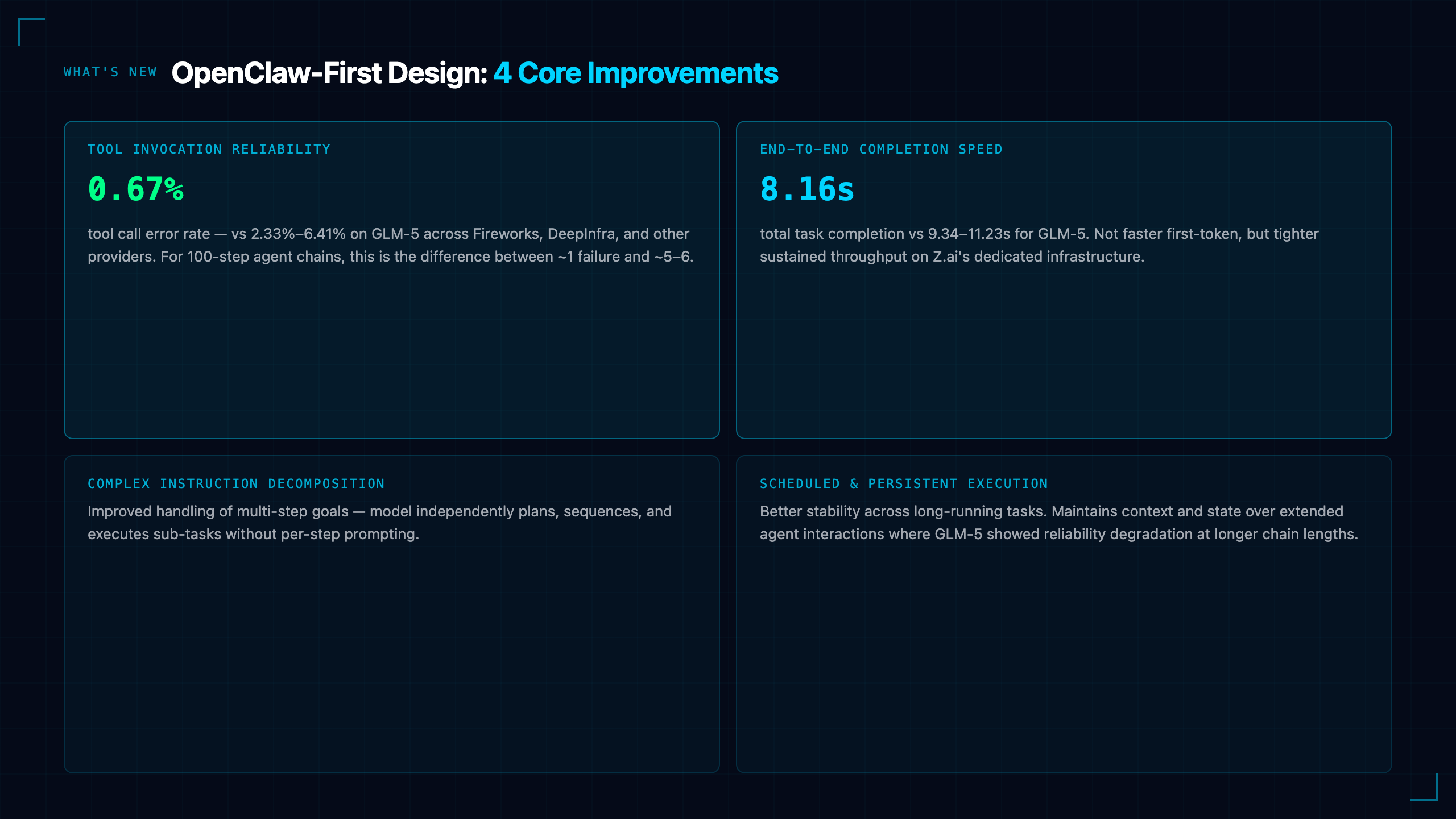
The technical case rests on one number that matters for agent deployments: 0.67% tool call error rate. For teams running long-horizon agent workflows, that difference from GLM-5's 2.33%–6.41% range across third-party providers isn't incremental — it's the difference between a system that requires constant supervision and one that can actually run unattended.
What's New: OpenClaw-First Design
GLM-5-Turbo is not a general-purpose upgrade to GLM-5. It's a targeted optimization for a specific class of workloads: OpenClaw-style autonomous agent tasks. The product positioning is precise — Z.ai describes it as built for real-world agent workflows involving long execution chains, not for the benchmark-maximization category.
The four capability improvements Z.ai highlights:
Tool invocation reliability. Tool call error rate drops to 0.67%, compared to 2.33%–6.41% seen on GLM-5 endpoints across Fireworks, DeepInfra, and other third-party inference providers. For agent workflows where dozens of tool calls happen per task, this compounds — a 2.33% error rate means roughly 1-in-43 tool calls fails; 0.67% means roughly 1-in-150.
Complex instruction decomposition. Improved handling of multi-step instructions that require the model to independently plan, sequence, and execute sub-tasks. This is the capability that makes the difference between an agent that needs step-by-step prompting and one that can take a goal specification and figure out the execution plan.
Scheduled and persistent execution. Better stability across long-running tasks where the model must maintain context and state over extended interactions — the type of workflow where GLM-5 on shared inference infrastructure showed degrading reliability at longer chain lengths.
End-to-end completion speed. 8.16 seconds total for representative benchmark tasks, compared to 9.34–11.23 seconds for GLM-5 endpoints. The throughput improvement is tied to Z.ai's dedicated infrastructure; first-token latency isn't necessarily faster, but completion time shrinks due to higher sustained token generation rate once streaming begins.
Architecture: 744B MoE, 200K Context
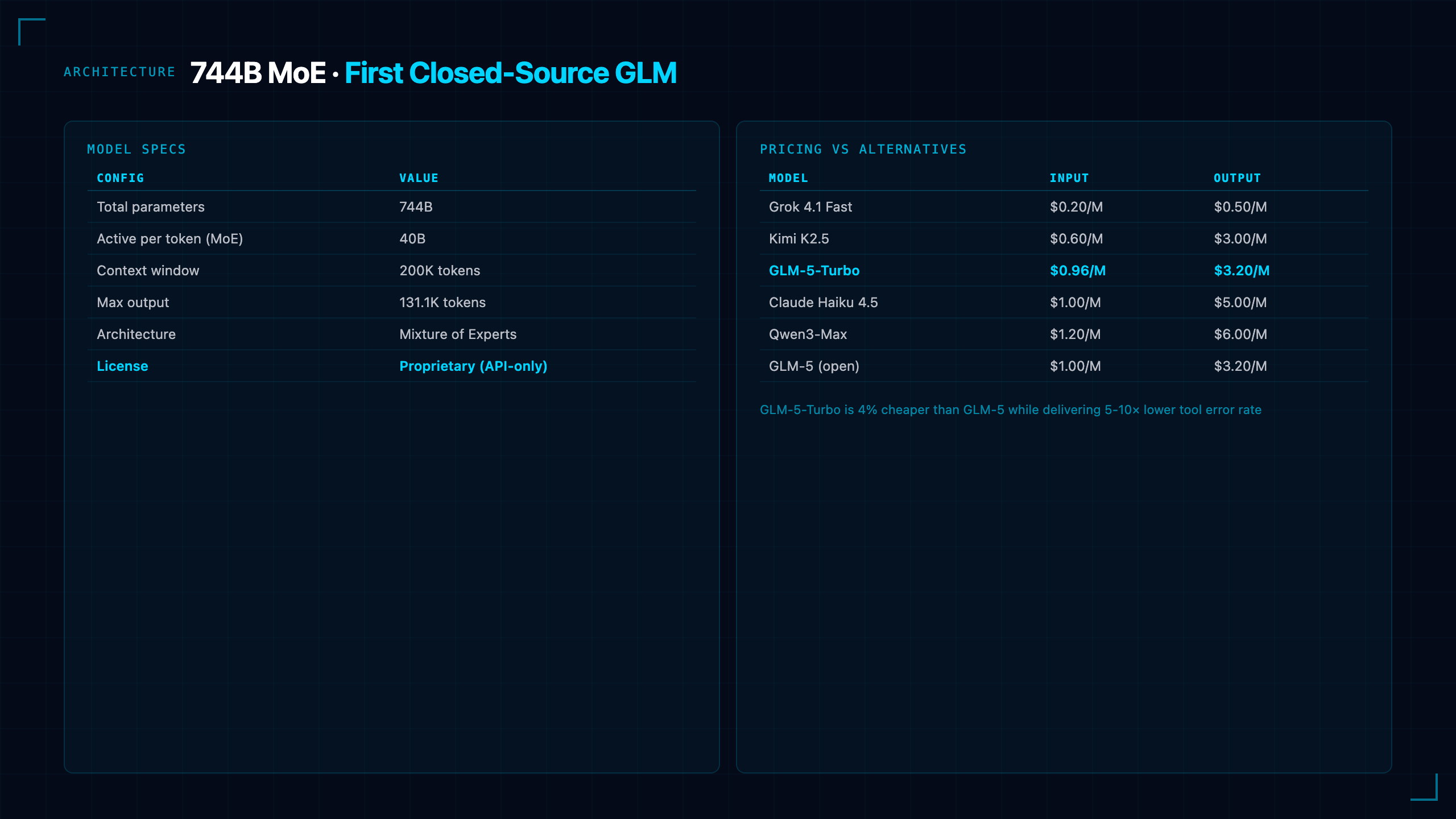
GLM-5-Turbo inherits the GLM-5 architecture without announced changes to the core model weights. The performance improvements come from inference-side optimization on Z.ai's infrastructure, not architectural modifications.
| Config | Value |
|---|---|
| Total parameters | 744B |
| Active parameters per token | 40B (MoE) |
| Architecture | Mixture of Experts |
| Context window | 200K tokens (202.8K) |
| Max output | 131.1K tokens |
| Input pricing | $0.96/M tokens |
| Output pricing | $3.20/M tokens |
| Availability | API only (Z.ai + OpenRouter) |
| License | Proprietary (closed-source) |
The 744B total / 40B active parameter structure is identical to GLM-5. MoE routing means most parameters stay dormant for any given token — what Z.ai has tuned is the reliability of execution on the active computation path, not the model's raw capability ceiling.
The 200K context window (technically 202.8K on OpenRouter) positions GLM-5-Turbo for long-document agent tasks: code repositories, legal document analysis, extended research workflows where context accumulation matters. The 131.1K max output is a meaningful ceiling for tasks that generate substantial structured outputs (reports, code, analysis).
Proprietary status. GLM-5 (the base model) is open-weight and available for self-hosting. GLM-5-Turbo is API-only. Z.ai's positioning is that the production optimization that produces the 0.67% error rate is infrastructure-dependent — it doesn't exist as a package you can run on your own hardware. This is the same architectural decision DeepSeek made with their proprietary API variants: you can run the open model, but the optimized production system is cloud-hosted only.
Benchmarks: ClawBench and Tool Reliability
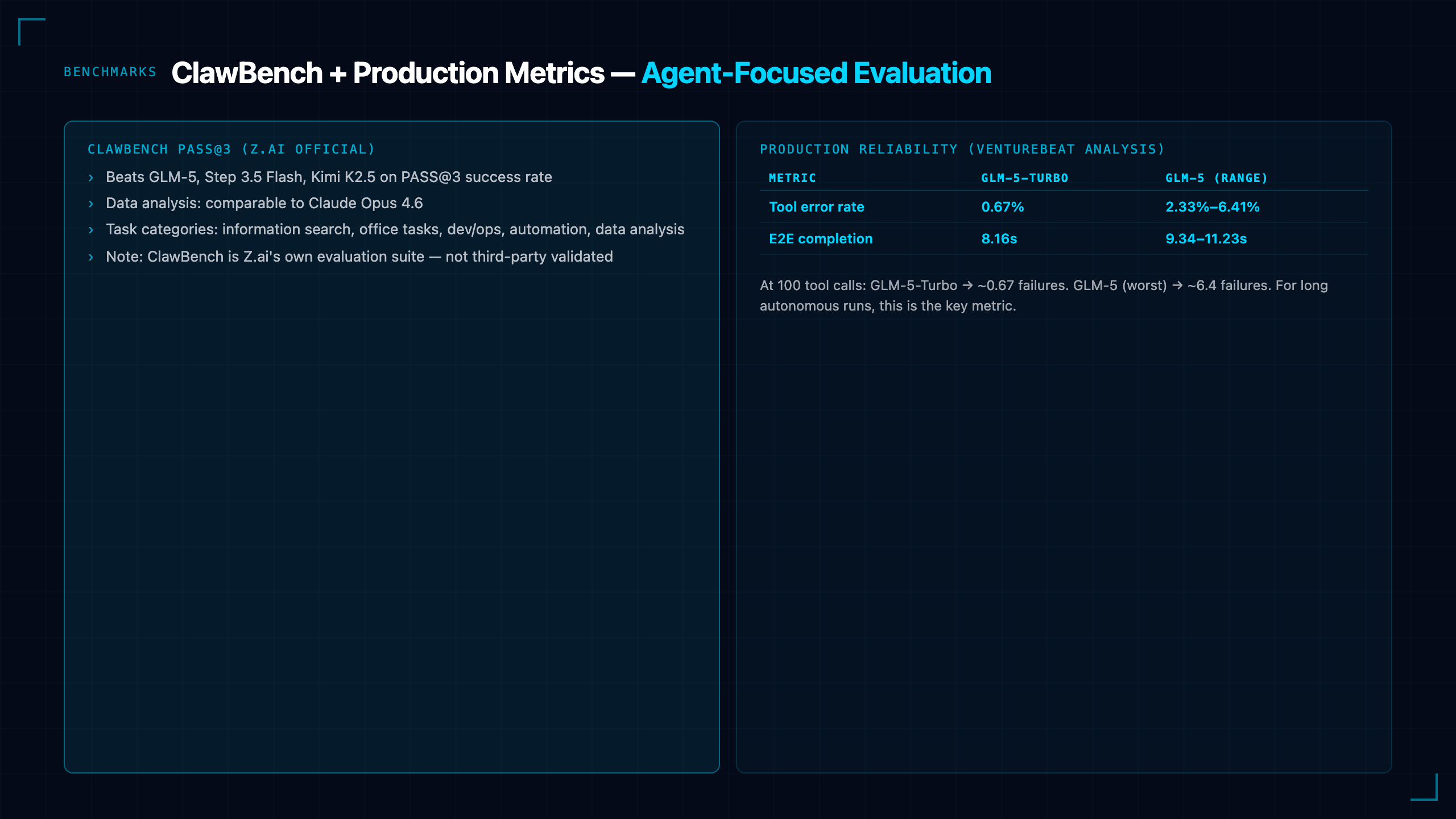
The benchmark framework Z.ai chose for GLM-5-Turbo is revealing. Rather than leading with MMLU or GPQA-Diamond — the standard academic benchmark set — the launch materials center on ClawBench, an evaluation suite specifically designed for OpenClaw agent scenarios.
ClawBench results (Z.ai official):
- PASS@3 success rate: exceeds GLM-5, Step 3.5 Flash, and Kimi K2.5
- Task categories: information search, office productivity, data analysis, development/operations, automation
- Data analysis: comparable to Claude Opus 4.6
Production metrics (VentureBeat analysis):
| Metric | GLM-5-Turbo | GLM-5 (range across providers) |
|---|---|---|
| Tool call error rate | 0.67% | 2.33%–6.41% |
| End-to-end completion time | 8.16s | 9.34–11.23s |
The caveats matter here. ClawBench is published by Z.ai's ecosystem; the benchmarks aren't third-party validated. The tool error rate comparison uses provider-hosted GLM-5 endpoints, not a controlled single-infrastructure comparison — meaning some of the error rate reduction may come from infrastructure quality, not just model-level changes.
That said, the metric itself is the right one to optimize for. Academic benchmarks measure capability ceilings; tool error rates measure production reliability. For agent workflows, the latter determines whether the system ships.
Pricing context (from VentureBeat comparison):
| Model | Input | Output | Total |
|---|---|---|---|
| Grok 4.1 Fast | $0.20/M | $0.50/M | $0.70/M |
| Gemini 3 Flash | $0.50/M | $3.00/M | $3.50/M |
| Kimi K2.5 | $0.60/M | $3.00/M | $3.60/M |
| GLM-5-Turbo | $0.96/M | $3.20/M | $4.16/M |
| Claude Haiku 4.5 | $1.00/M | $5.00/M | $6.00/M |
| Qwen3-Max | $1.20/M | $6.00/M | $7.20/M |
GLM-5-Turbo sits at $4.16/M total — above the Kimi K2.5 cluster but below Claude Haiku 4.5. The positioning is explicit: better tool reliability than cheaper alternatives, lower cost than the Western frontier models it benchmarks against on data analysis.
Access and Subscription Tiers
GLM-5-Turbo is available through two channels:
API access:
- OpenRouter: $1.20/M input, $4/M output (OpenRouter pricing may differ from Z.ai direct)
- Z.ai direct API: via docs.z.ai for enterprise accounts
GLM Coding subscription (Z.ai's coding assistant product):
| Tier | Price | GLM-5-Turbo availability |
|---|---|---|
| Lite | $27/quarter | April 2026 |
| Pro | $81/quarter | March 2026 (immediate) |
| Max | $216/quarter | March 2026 (immediate) |
The subscription tier structure is notable: Z.ai is using GLM-5-Turbo as a differentiator to push users from Lite to Pro, not just an API product. That's a different go-to-market than a pure API play — it means Z.ai is treating GLM-5-Turbo as infrastructure for their coding assistant product line, not just an API offering for developers building their own agents.
Enterprise access: Z.ai was accepting early-access applications at launch, suggesting capacity constraints at the initial rollout.
What It Means for Developers
The key decision point is the trade-off between the open GLM-5 and the proprietary GLM-5-Turbo.
GLM-5-Turbo vs. GLM-5 (open weight):
- If you're running GLM-5 on Fireworks or DeepInfra, you're seeing 2.33%–6.41% tool error rates. GLM-5-Turbo's 0.67% is a ~5-10x improvement at a small price premium. For long agent chains, this math works out clearly.
- If you're self-hosting GLM-5, you control the infrastructure. Your error rates may differ. The Turbo variant isn't available to self-hosters — you'd need to evaluate whether your own inference stack can match Z.ai's tool reliability.
GLM-5-Turbo vs. Kimi K2.5:
- K2.5 is priced at $0.60/M in + $3.00/M out vs. GLM-5-Turbo's $0.96/M in + $3.20/M out. K2.5 wins on price. GLM-5-Turbo's pitch is task reliability on OpenClaw-specific benchmarks, not general capability.
GLM-5-Turbo vs. Step 3.5 Flash:
- Direct ClawBench competitor, per Z.ai's own benchmark. GLM-5-Turbo claims higher PASS@3. No independent validation yet.
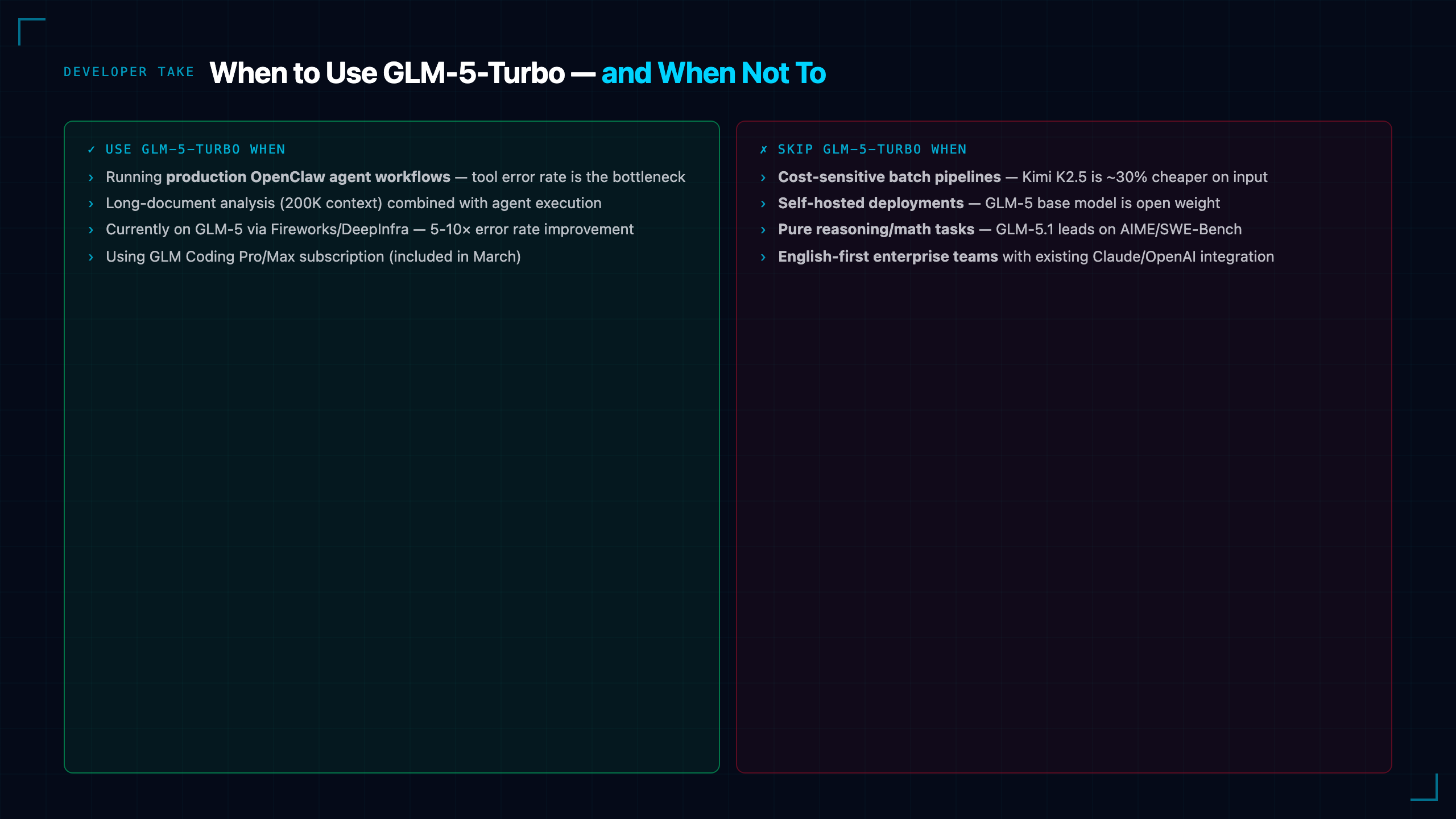
When to use GLM-5-Turbo:
- Production agent workflows on OpenClaw scenarios where tool error rate is the limiting factor
- Long-document analysis (200K context) combined with agent execution
- Teams already using Z.ai's ecosystem (GLM Coding subscription) who want the Pro-tier upgrade
When to use something else:
- Cost-sensitive batch pipelines: Kimi K2.5 is ~30% cheaper on input
- Self-hosted deployments: GLM-5 base model is open weight
- Pure reasoning / math tasks: GLM-5.1 is the higher-capability option on AIME/SWE-Bench metrics
- English-first enterprise tasks with existing Claude/OpenAI integration: switching costs may not be worth it
The proprietary close is the longer-term signal. Z.ai built their reputation on open-source GLM models. Choosing to go closed-source for the agent-optimized production variant suggests they believe the production reliability story is real, and that they can compete with Western model providers on enterprise agent deployments — not just on raw capability benchmarks.
Bottom Line
GLM-5-Turbo is a pragmatic product decision: Z.ai took GLM-5's open-weight architecture, optimized it for OpenClaw agent deployments on their own infrastructure, and closed the source. The result is a 0.67% tool error rate, 8.16-second end-to-end completion time, and ClawBench PASS@3 results that beat GLM-5, Step 3.5 Flash, and Kimi K2.5. Pricing at $0.96/M in + $3.20/M out sits in the middle tier — cheaper than Claude or GPT for comparable agent tasks, more expensive than the cheapest Chinese model API options. For teams running production OpenClaw workloads, the tool reliability improvement is the argument; for everyone else, the open-weight GLM-5 remains the more flexible choice.
Resources
- Z.ai API Documentation — API access and pricing
- OpenRouter GLM-5-Turbo — third-party API endpoint
- ClawBench Evaluation — OpenClaw agent benchmark suite
- GLM-5 Open Weights — base open-source model on HuggingFace
GLM-5-Turbo is available via API at z.ai and on OpenRouter. Pricing: $0.96/M input, $3.20/M output. 200K context window. Enterprise access applications accepted via Z.ai.